From the Editorial Team
Ethnozoology, a sub-discipline of ethnobiology, is the study of the relationships between human cultures and the animals in their environment and how different cultures think about those animals. It includes classification and naming of zoological forms, understanding cultural knowledge and documenting use and management of wild and domestic animals.
In past issues we have included articles about ethnoornithology. This issue of the ISE Newsletter focuses on this interesting sub-discipline, as three ISE members share their research with elephants, triatomines and bees.
Also in this issue are Research Reports from the Field: on wild edible plants in South India and Ethiopia, the role of ceremonies in preserving biocultural diversity among the Loita Maasai, and reflections on the Bribri and Cabecares in Costa Rica.
We hope you enjoy!
Natasha Duarte, Sarah-Lan Mathez-Stiefel and Leslie Main Johnson
Ethnozoology
 Ethnozoology of Human Elephant Relations
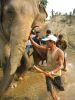
Contributed by Kierin Mackenzie and Dr. Piers Locke. Humans and elephants coevolved in Africa from earlier species. Humans have always lived alongside these amazing beings, and we share much in common with them. Both elephant and human young take a long time to mature. Both share complex social networks. Both communicate in a myriad of ways with fellow species members. Both mourn their dead…
 Ethnobiological studies about triatomines (Hemiptera, Reduviidae), vectors of Chagas disease in Bahia State, northeastern Brazil
Submitted by Eraldo Medeiros Costa Neto and Rodrigo Gurgel Gonçalves. The American trypanosomiasis, or Chagas disease, is an endemic zoonosis in the Americas and its etiologic agent is the haemoflagellate parasite Trypanosoma cruzi, which is transmitted by feces of blood-sucking insects of the subfamily Triatominae (Hemiptera, Reduviidae). The total prevalence of Chagas disease was reduced from >16 million to 8 million people, estimated in 2005, and numbers of deaths were also reduced drastically…
 The Sentimiel Initiative: Linking traditional ecological knowledge on honey harvesting and beekeeping in a changing world
Contributed by Edmond Dounias – UMR5175 Center for Functional and Evolutionary Ecology, France. Funded by the French Foundation for Biodiversity Research (Fondation pour la Recherche sur la Biodiversité), Sentimiel — a play of word with ‘sentinel’, ‘miel’ being the French term for ‘honey’ — is a citizen science operation with the twin aims of i) constructing a network of cooperative initiatives around traditional beekeeping and honey harvesting at the international level and ii) ensuring, via this network, the monitoring of effects of global changes, viewed through the prism of their impact on bees and on their production of honey and associated products…
Research Reports from the Field
 Present scenario of user knowledge and availability of Wild Edible Plants in Male Mahadehswara Hills, South India
Contributed by Harisha Ranganahalli Puttahariyappa. I have been chronicling the use of Wild Edible Plants (WEPs) species in the Male Mahadeshwara (MM) Hills Reserve Forest region since 2009. The motivation for this study came through interactions with the community, which time and again returned to the subject of disappearing useful species…
 Wild edible plants in Ethiopia: a review on their potential to combat food insecurity
Contributed by Ermias Lulekal; Co-authors: Zemede Asfaw, Ensermu Kelbessa, Patrick Van Damme, Shared with permission from Afrika Focus (Volume 24, Nr. 2, 2011. pp. 71-121). This work reviews literature on ethnobotanical knowledge of wild edible plants and their potential role in combating food insecurity in Ethiopia. Information on a total of 413 wild edible plants belonging to 224 genera and 77 families was compiled in this review…
 The role of ceremonies in preserving cultural diversity and conserving biodiversity for sustainable livelihoods
Contributed by Henri ole Saitabau. Exploring cultural diversity and related indigenous knowledge among the Loita Maasai community: Emanyatta oo Lorikan. Cultural diversity is an ethnobiological aspect enshrined within the indigenous knowledge systems. Such systems have remained impeccable in practice and have ensured preservation of culture and community distinctiveness among the Loita Maasai, factors they share in common with other indigenous community around the world…
A Note on the Bribri and Cabécar Peoples
Contributed by Ali Garcia; Abstract in English by ISE Student Representative, Olivia Sylvester.Written by Bribri scholar Alí García, this note in Spanish provides a background on the history and the current situation of the Bribri and Cabécar peoples in Talamanca, Costa Rica…
Ethnobiologists’ Bookshelf
The Living Convention on Biocultural Diversity
Contributed by Harry Jonas and Holly Shrumm. The Living Convention on Biocultural Diversity: A Compendium of Indigenous Peoples’ and Local Communities’ Rights Relevant to Maintaining the Integrity and Resilience of Territories and other Biocultural Systems contains a comprehensive compilation of international legal provisions organized into categories of rights that support the stewards of biocultural diversity. It is intended to serve as a useful resource for Indigenous Peoples, local communities, NGOs and others who want to reference and use international law at the national and local levels. A first draft of the publication has been completed and we welcome its rigorous peer review…